"How to become an Olympic skeleton athlete" FAQ
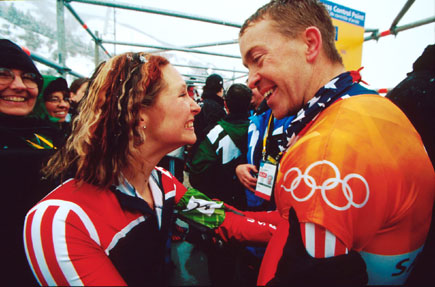
USA's Tristan Gale and Jim Shea, '02 gold medalists. (Photo: US News & World Report)
1) How much experience do skeleton sliders have at the Olympic level?
The gold medalists in 2010 were 30-year old Jon Montgomery (CAN) and 27-year old Amy Williams (GBR), both of whom started sliding in 2002. Sliders in the 2010 Olympics ranged in age from 21 (Elena Yudina, RUS) to 45 (Kazuhiro Koshi, JPN). While most of them had at least several years of experience, Anthony Deane (AUS), age 25, qualified for the Olympics just 12 months after his first slide.
2) So, what does it take for a skeleton athlete to excel in competition?
In my opinion, competitive skeleton athletes ideally demonstrate these qualities, in order of importance:
1) Courage. Can you envision yourself calmly maintaining focus while zooming down a track at 80 mph, even as you're getting banged up along the way? Competitive sliders will inevitably suffer crashes or injuries, but those who perservere and are eager to return to the track tend to excel.
2) Quick thinking and physical dexterity. You'll use your body to make many subtle steering movements in a matter of seconds.
3) Sprinting ability. A good performance is partly dependent on a fast push start, in which you're using one or both arms to shove a sled weighing up to 95 lbs (43 kg) for roughly 30 meters.
4) High body weight (preferably). The physics of this sport dictate that heavier objects reach the finish line faster. This may be the only Olympic sport besides swimming where some body fat (to a point) is beneficial, although lean muscle mass is more effective. Gold medalist Duff Gibson weighed 100 kg (220 lbs), although small athletes can do well, like 2002 women's Gold medalist Tristan Gale (108 lbs / 49 kg). Lighter athletes are allowed to use heavier sleds to partially mitigate weight advantages.
3) Are there any sports that tend to produce successful skeleton athletes?
As someone who formerly competed in hurdles -- and taken luge lessons -- I can't help but notice that nearly half of US Olympians in 2006 and 2010 had a background in either Track & Field or luge.
US Olympians who have made the switch from luge to skeleton -- Zach Lund, John Daly, and Olympic alternate Chris Hedquist -- have used their prior experience to master "racing lines" on the track.
Track & Field athletes often excel in skeleton, especially those who competed in the hurdles or the decathlon/heptathlon, including US Olympians John Daly, Noelle Pikus-Pace, and Kevin Ellis (who also competed in the 110 meter hurdle Olympic Trials). Such athletes tend to have good sprinting ability and body coordination, and have demonstrated they're "crazy" enough to be fearless in the face of crashing.
Many current and former elite skeleton sliders also have a background in other physically-demanding activities, including stuntman (Chris Soule, USA; Iain Roberts, NZL; Matt Griff, USA [see Matt's awesome skeleton-related stunt reel]), gymnast, and firefighter (Duff Gibson, CAN; Lee Ann Parsley, USA).
4) Other than sliding, what does skeleton training consist of?
The training regimen for a skeleton athlete typically emphasizes sprints, plyometrics, weight training (like power cleans and squats), and practicing starts on the push track.
5) How much does an elite athlete have to spend?
A lot!
While a beginner may buy a basic secondhand sled for around $500 to $2,000 (US dollars) or rent a club sled, serious athletes will need a higher-quality sled (plus runners) that may cost $2,500 to well over $5,000. I was stunned to read news reports that 2010 gold medalist Amy Williams (GBR) spent 100,000 British Pounds, or around $155,000 US dollars, on her sled! The other gold medalist, Jon Montgomery (CAN) reportedly spent "just" $7,000 Canadian dollars, or around $6,600 US dollars, for his sled.
On top of that, you'll have to factor in the cost of a helmet, speedsuit, spikes, sliding fees, and travel to various competitions. Due to all these expenses, athletes tend to spend lots of time seeking sponsors or donors.
6) What must I accomplish in order to become an Olympian?
Procedures vary by country, but here's the typical progression in the USA:
Novice Practice Slides -> Club Races -> Regional Championships -> National Time Trials -> America's Cup Team -> Europa Cup Team -> Intercontinental Cup Team -> World Cup Team -> Olympic Team
The field quickly shrinks with each step. While there may be a couple dozen competitors at each club race, only three American men and women make the World Cup Team.
7) Compared to other Olympic sports, how hard is it become an Olympian in skeleton?
A reason why skeleton may appeal to aspiring Olympians is that it's one of the "easiest" Olympic sports to medal in. Well, certainly not easy, but far "less impossible" than for established sports like soccer or hockey. After all, if you become a competitive slider (even a mediocre one), that ranks you in approximately the top 0.00001% of the world's population. This is especially true for women, considering the sport's fairly high ratio of male-to-female participants. In fact, various news articles have noted that Australia -- in efforts to maximize the number of Olympic medals -- has targeted its women's skeleton program for extensive recruitment and development efforts. This effort has been very successful in generating several Olympians who previously lacked any competitive experience in winter sports.
Many of the top athletes started this sport on a whim or through some serendipitous connection (such as coincidentally living near a track), which gives this sport some of its charm. But it's increasingly becoming as ultra-competitive as other Olympic sports, where countries invest great resources in recruiting and grooming full-time athletes from a very early age.
8) How else can I realize my Olympic dream?
Sometimes, an athlete who has some connection to a country with a less developed skeleton program will switch his/her sliding affiliation to that country in order to qualify for the Olympics.